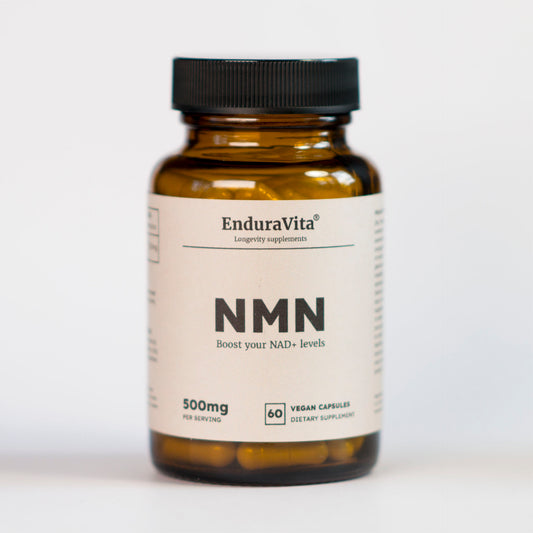
NMN (Nicotinamide Mononucleotide): targeted support for NAD⁺ and cellular energy
A consistent finding within modern aging science is that the body produces less and less NAD⁺ over the years. NAD⁺ is an essential molecule needed for energy production in the mitochondria, for DNA repair, and for the activation of sirtuins (proteins involved in metabolism), inflammation regulation, and cellular stress resistance. When NAD⁺ levels decline, these processes function less efficiently, contributing to multiple Hallmarks of Aging, including mitochondrial dysfunction, genomic instability, and dysregulated nutrient sensing.
NMN is a direct building block of NAD⁺. In the body, NMN is converted into NAD⁺ via NMNAT enzymes, thereby directly contributing to the intracellular NAD⁺ pool. At the molecular level, this means that cells are better able to produce energy, repair DNA damage, and defend themselves against oxidative and metabolic stress. This relationship between NAD⁺ decline and aging is described in detail in a mechanistic review in Cell Metabolism, which explains how restoring NAD⁺ levels supports mitochondrial function and cellular resilience.¹
A review in Nature Reviews Molecular Cell Biology also confirms that NAD⁺ depletion plays a central role in aging by putting repair mechanisms under pressure and amplifying chronic inflammation.²
Crucial is that these mechanistic insights have now also been confirmed in humans. In a randomized, double-blind, placebo-controlled study, Yi et al. (2023) investigated the effect of oral NMN supplementation in healthy adults. Participants received NMN in different dosages for several weeks. The researchers reported a significant and dose-dependent increase in NAD⁺-related metabolites in the blood, including NAD⁺ itself. This shows that NMN is indeed absorbed in humans and utilized to increase NAD⁺ status.³
In addition to these direct biomarker data, there are also human studies showing that NMN can influence processes relevant to healthy aging. In a study published in Science, Yoshino et al. (2021) investigated NMN supplementation in women with prediabetes. They found that NMN improved the insulin sensitivity of muscle tissue, which is important because metabolic flexibility is strongly associated with the pace of aging.⁴
Animal research further supports this picture. In an influential study in Cell Metabolism, Mills et al. (2016) showed that long-term NMN supplementation in aging mice led to improved mitochondrial function, higher physical activity, and protection against age-related metabolic decline.⁵
Together, these studies show that NMN is not merely a theoretical longevity molecule, but a substance whose biological action and effectiveness in humans are demonstrable. By supporting NAD⁺ levels, NMN can contribute to maintaining cellular energy, metabolic health, and recovery capacity—core components of a long and healthy phase of life.
NMN is therefore a scientifically substantiated building block within a broader longevity strategy for those who not only want to live longer, but above all want to remain vital longer.
Sources:
1. Lautrup et al., Cell Metabolism (2019) – NAD⁺ in aging
https://www.cell.com/cell-metabolism/fulltext/S1550-4131%2819%2930502-9
2. Covarrubias et al., Nature Reviews Molecular Cell Biology (2021) – NAD⁺ metabolism and aging
https://www.nature.com/articles/s41580-020-00313-x
3. Yi et al., GeroScience (2023) – Randomized clinical trial NMN https://doi.org/10.1007/s11357-022-00705-1
4. Yoshino et al., Science (2021) – NMN and insulin sensitivity
https://www.science.org/doi/10.1126/science.abe9985
5. Mills et al., Cell Metabolism (2016) – Long-term NMN in aging mice
https://www.cell.com/cell-metabolism/fulltext/S1550-4131%2816%2930495-8